- Degenerate Art
- Posts
- March 5 Thursday roundup
March 5 Thursday roundup
Links to the podcast! Also, if you're feeling overwhelmed, join our call tonight.
In this week’s podcast episode, I talk about Trump’s war on Iran and OpenAI’s announcement that it would partner with the U.S. government—an announcement that came just hours before the bombing started. You can watch the episode on YouTube or listen to it on Apple, Spotify, and elsewhere. If you’d like to check out the linked material or the written post from Tuesday, you can read it here.
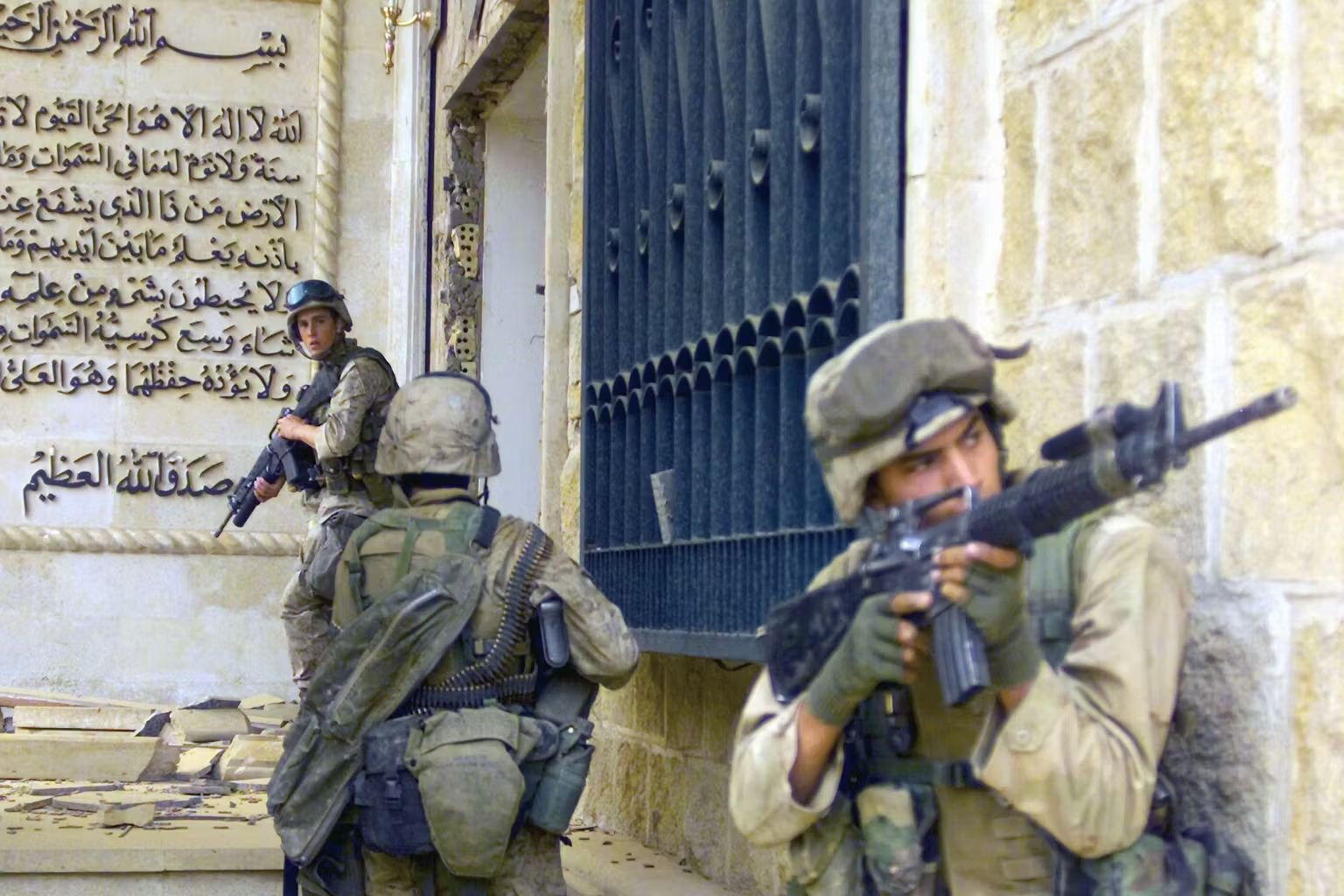
US Marines prepare to enter one of Saddam Hussein’s palaces in Iraq, April 2003. (Photo: U.S. Marines)
Usually I post the big essay on politics and history for the week on Tuesday, and a second, shorter post each week on Friday. But I’ve bumped up the Friday post a day because I wanted to remind you about a conversation I’ll be part of this evening that might be interesting or useful to many subscribers.
At 7pm ET, I’ll be on a national call with 50501. If you don’t know 50501, it came into existence as a nonviolent decentralized rapid response movement responding to the Trump administration’s executive overreach. The call will kick off with Frank Abe, who has done so much to memorialize the nightmare of the concentration camps the U.S. used for Japanese American citizens and noncitizens alike during World War II, as well as the lives of those who were detained in those camps.
Sarah Parker, 50501’s national coordinator and I will then be in conversation about the historical roots of what’s happening and where the U.S. is at in terms of mass detention now. We’ll also hear from those who have managed to deny or delay acquisition of warehouses for immigrant detention in their communities. And there will be Q&A afterward. I hope you’ll register here for the call and join us.
This moment can be really overwhelming, with multiple overseas military operations and so much harm happening to vulnerable people across the country and around the globe each day. I remember this same sense of damage being inflicted everywhere at once during a two year period that began with the 9/11 terror attacks.
The morning of that attack more than a quarter-century ago, my husband had been on a call in his newsroom, getting a comment from a national security expert about planes hitting the World Trade Center. Looking out the window, he saw an explosion past Arlington Cemetery at the southwest side of the Pentagon. Reaching out to touch the glass, he felt a tremor, a faint shock wave from the blast. Smoke rose in the distance.
Neither of us owned cell phones at that point. He called from his office line to say he was headed to the blast site then hung up. He jumped in a pickup truck car with a photographer to get to where the plane had hit. As I went about my day—talking to my clients to decide if we would still hold martial arts training and self defense classes I was teaching in the community—for the next several hours, I didn’t know where he was.
Weeks after the collapse of the Twin Towers, the U.S. invaded Afghanistan, with the goal of overthrowing the Taliban. I recall sitting in my car in DC, listening to WTOP news radio and hearing that U.S. forces were invading Afghanistan. I pulled over to park, overcome by a terrible sense of dread. The need to respond to the Taliban was real, but the prospect of invading Afghanistan echoed so much horrific history, I was afraid the U.S. was launching a catastrophe.
That operation began in early October 2001. Even before that—starting just days after the 9/11 attacks—letters laced with anthrax began to circulate through the U.S. postal system. The first set were sent to print and TV journalists. The next set went to politicians on Capitol Hill. Five people died in all, including two postal workers, and nearly a dozen became seriously ill. Media companies changed mail reception and delivery, and regular folks began examining their mail outside at arm’s length and washing hands after they opened it. Like the military campaign in Afghanistan, there was no end in sight. Month after month dragged by; Osama bin Laden wasn’t captured, and the anthrax culprit wasn’t caught.
Almost a year later, On October 2, 2002, a 55-year-old NOAA analyst was killed in an assassination-style shooting at a parking lot in Wheaton, Maryland, in the suburbs of Washington, DC. The next day, five more people died the same way in Maryland and just across the state line in DC.
The sniper-style shootings continued in Virginia, DC, and Maryland for three weeks, including a 47-year-old FBI analyst shot in the head in the parking lot of the Home Depot in Falls Church, where I live. During that time, everyone was on the lookout for white vans, which had incorrectly been announced as the likely vehicle being used by what became known as the Beltway Bandits. By the end of the month, the two gunmen were caught, as a result of one sniper leaving messages at the scene of the crimes to taunt his pursuers, as well as calling the authorities himself.
By then, the Bush administration was already focused on ginning up a war against Iraq. Officials courted our allies for months, and even managed to get the United Nations Security Council to pass a resolution that November that Iraq was in material breach of its agreement to disarm. Eventually, Colin Powell made his February 2003 presentation to that same Security Council, in which he misrepresented the actual threat that Iraq posed and the state of its weapons programs. The UN did not subsequently vote to support a U.S. invasion of Iraq. The Bush administration launched a war of choice on March 20, 2003.
Overseas in Europe for a conference at the time, I didn’t support the war, though I had no clear picture of the state of Iraq’s weapons program and couldn’t authoritatively evaluate U.S. claims about it. The day before I flew home, however, I met up with an acquaintance, who’d reported on weapons programs for years, and had sources who were involved in verification and other aspects of arms control.
He noted that U.S. forces would find nothing in Iraq, because there was nothing to find. A normally cautious reporter, he said it definitively. Again, I felt that wave of horror over what I then knew would happen—what the consequences of malice or incompetence would be for American democracy, not to mention the countless civilian deaths abroad that were sure to follow, for no purpose at all.
Those eighteen months between 9/11 and the U.S. invasion of Iraq were exhausting and incredibly dispiriting. I recognize the feeling today. But the truth is, as I mentioned Tuesday, 2026 is not 2003. Trump is extremely unpopular. He holds all the levers of power, but is nonetheless in a shaky position. Everything that eats away at his control—from attention to the Epstein files to inflation due to tariffs sparking disapproval and ICE abuses sparking righteous fury—is making him weaker.
I’ve said before that this year is going to feel like a century, but there’s a growing clarity in the country about Trump, and a growing, organized movement to reject the policies of authoritarianism and hate. And this time out, there’s also a realization by a broader swath of the public that coming back from horrors like the ones we’re seeing—like the ones Trump is inflicting at home and abroad—requires more than just closing a door on the past. It requires accountability and systemic change that will keep the same abuses and crimes from happening again.
But for now, it’s up to us to continue fighting against the administration and its reprehensible goals, to put an end to its murder and mayhem. And joining me on the 50501 call is one way you can do that. I hope to see you tonight.
Reply