- Degenerate Art
- Posts
- What just happened
What just happened
Weekend protests, the centrist fallacy, and the void. Where do you stand?
The first weekend in January delivered the U.S. kidnapping the de facto Venezuelan president. The second weekend brought an official announcement from the chairman of the Federal Reserve that he’s being targeted by the administration for prosecution, because the president wants to control monetary policy.
In between, a Minneapolis mom was shot in the head in broad daylight, a woman our government has since been trying to portray as a terrorist. Since the killing, ICE has doubled down on its police-state punishment of the city for daring to be unhappy about murder in their midst.
On Sunday, in the wake of the killing of Renee Good, federal agents in Minneapolis came face to face with a driver they accused of obstructing them. They told the driver to stop. The driver said that he was on his way home, and that he served the Lord. He suggested the agents go to church. One responded with a thinly veiled threat, asking the driver, "Did you not learn from what just happened?"
In the last week, far from being cowed, ICE has gotten more aggressive in more places at once. Combine this recent brutality with elections coming near the end of this year, as well as the continued attacks on the rule of law, and the current state of affairs can feel pretty overwhelming.
Today I want to consider how to manage the vast mess confronting us and why it’s so hard to process in the mind. I’ll address the ways ICE’s goal is to overwhelm opponents mentally before they ever take action, and offer a simpler approach for how to take these crises in. I’ll talk about attending some of the protests from last weekend, and other ways to respond to the violence and hate around us.
Our national crisis is going to get worse before it gets better. But you don’t have to spend your life feeling helpless or marinating in fear and fury.

A demonstrator hoists a homemade sign at DC’s ICE Out protest. (Photo: A. Pitzer)
Constant torrent of news
First, let me be clear that if you are happy with your social media presence, love sparring with critics, and don’t feel overwhelmed by our era, a good chunk of this post may not be relevant for you. I’m not in any way trying to bend everyone to my will or say that people should only be online in one particular way.
Secondly, I’ll say that I am personally allergic to self-help books and podcasts, and today’s topic might veer dangerously close to those, so feel free to ignore anything that feels like a lecture.
If, however, you’re feeling beat down and mad at the whole world—or even if it’s only at the people who post in your feed or show up in your mentions—maybe some part of what follows today will be useful. I’d like to suggest that you can’t see the forest when you’re busy running nonstop face-first into more trees.
World’s best expert
With nearly everyone on one platform or another, a constant connection to current events can become a plague of knowledge. And with the speed of events unfolding in the second Trump era, combined with the instant ability to post reflections on them, most hardcore news junkies (myself included) not only have an opinion on everything, but are willing to post those opinions, and sometimes try to one-up each other.
But you cannot actually win the internet. Nobody outside perhaps five or six disinformation researchers is ever going to get the “world’s best information expert” badge. If you aren’t already getting paid to stay current and post about the news (and maybe even if you are), online existence shouldn’t be a replacement for the rest of your life.
There are definitely some exceptions to what I’m about to say, particularly among disabled folks and those who are profoundly isolated. But overall, the people who are changing the situation on the ground aren’t spending the majority of their time on social media.
And though I think history is important and those of us who are Americans should learn a lot more of it in general, you don’t have to become an expert on Venezuela, or on the history of the Federal Reserve before you can push back against the larger Trump project. You don’t have to have perfect knowledge and authority to respond to each of the administrations bad-faith arguments or to act against its agenda.
Online trash can
On the internet, we all run the risk of being merely the receptacle of the garbage that’s being produced. How much are you interacting with others online in ways that no longer feel instructive or fun? Do you find yourself echoing accounts that only lecture you on how hopeless and bad our current situation is? Do you feel reassured by other posters who reflect your anxiety through panicked graphics and desperate language with a lot of exclamation points?
Conversely, do you swallow online fare that reassures you day after day that Trump is on the verge of getting what he deserves? Do you interact with anyone online who is actually doing anything to change the situation we’re in?
I’ve mentioned before that I think a lot of people might be accidentally training themselves into powerlessness, and ending up just observing what’s happening as if it’s on television. Countless influencers are throwing unprocessed emotion out, hoping their takes will spark a garbage fire in which heat might be mistaken for influence. But they can only do it with your help. They can only do it if you collect their garbage.
Shit competitions
Just as harmful as what we do to ourselves is what we do to one another. I’m not talking about debate or discussion with poasters [sic] you know in real life, or those who share an environment or background with you, or people who work in the same field.
I’m talking about your interactions with strangers. I don’t have a celebrity-level following on Bluesky, but I do have a little community of followers. And I’m sometimes surprised what they put in my mentions. One time, I was at a protest, just documenting signs people were carrying and posting interviews with attendees, and someone who agreed entirely with the message of one of the signs reposted it with criticism, arguing that the demonstrator should have used stronger language the critic preferred. Another person took issue with a different sign at the same protest.
It’s all too easy to police the language on the sign someone else took the time to make and carry out on the street, ready to encounter whatever might follow. But before you make any effort to criticize people out there, it might be worth asking yourself, “Am I about to criticize someone who likely agrees with me about the big issues confronting us? Am I about to take issue with someone doing good work in a way that is going to wear down motivated people?”
No one is above criticism. But I see more extreme versions of this online all the time—furious attacks on people who share the vast majority of the attacker’s political outlook and goals. And pointless armchair commentary can be especially dispiriting day after day if it’s directed at the people who are actually showing up to do something.
Just as big an issue is that people often seem to feel that their online criticism is equivalent to taking action themselves. People are going to have to show up for one another in public more than they tear each other down if we want to destroy the expanding police state.
This is not a post about hopelessness, however. Last weekend countless Americans went out into the streets coast to coast, with more than a thousand events around the country. Here in the D.C. metro area, there were several smaller events in the suburbs, from an anti-ICE gathering on the overpass above Interstate 66 in Falls Church to ongoing anti-Musk Tesla protests and the weekly Saturday gathering at NIH in Bethesda.

Demonstrators arrive in the rain for the weekly gathering at NIH.
On Sunday, I stopped at the Arlington, Virginia “ICE Out” rally on my way into DC. Hundreds had gathered at the Court House there to hear speakers and shout about ICE, as well as to learn about how to get skills on dealing with immigration enforcement and protecting those targeted by out-of-control thugs.

An ICE Out crowd gathers at the Arlington Court House. (Photo: A. Pitzer)
After that, I hopped on the metro, and ran into others on the train heading to the protest as well. Walking down toward Constitution Avenue, I met Terri, who explained that she had been an activist for years, going back to the days of Act Up.
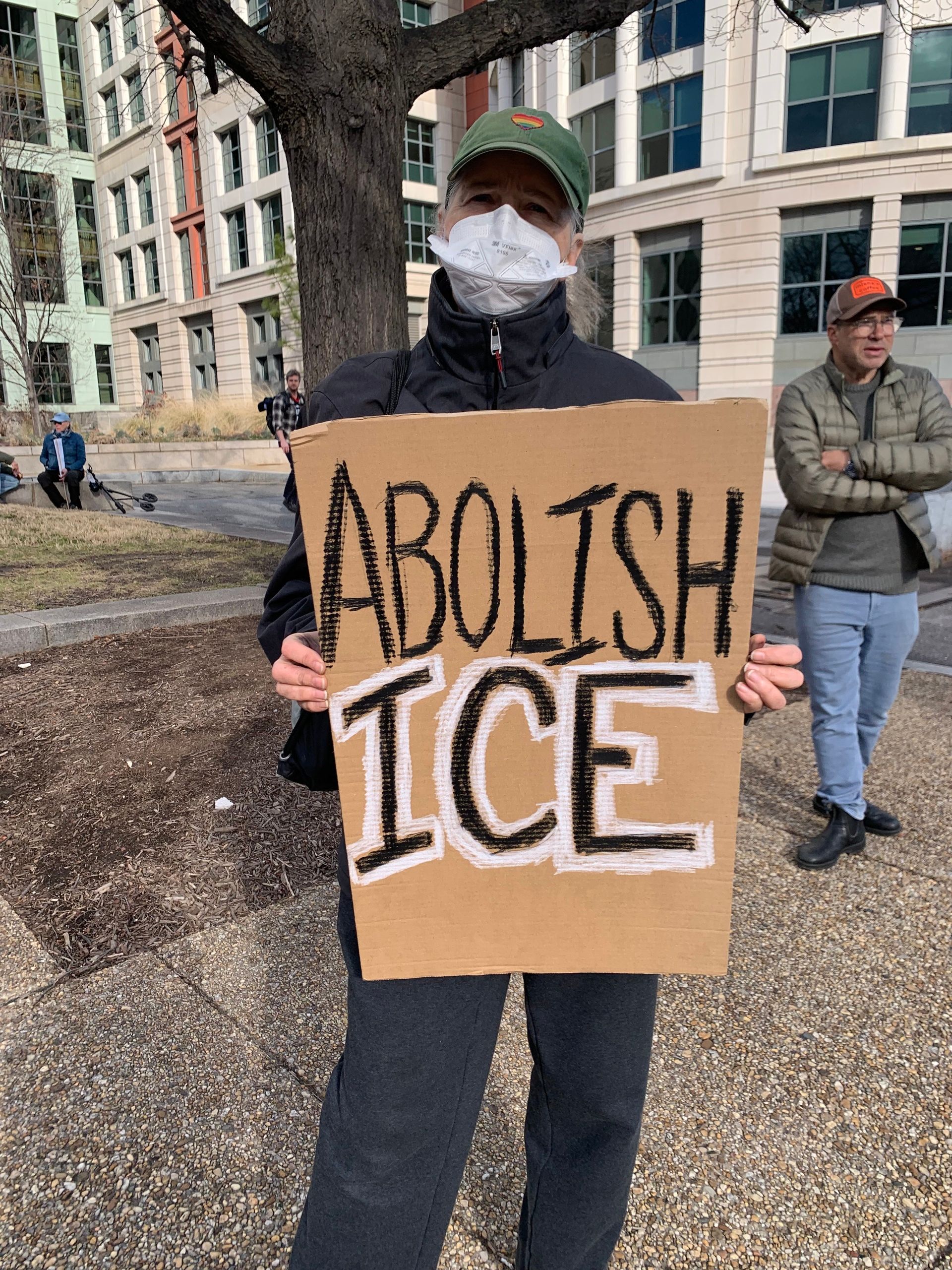
Terri on her way to the demonstration Sunday in D.C.
“I lived in Manhattan for twenty years, and I was involved in ACT up during the AIDS epidemic, “ Terri said. “Of course living in Manhattan we were all—New Yorkers—very aware of what a carnival barker Trump has been for many years. The idea that this one man has changed the entire world order is just shocking.”
Asked what brought her out on the streets, she answered, “So much, so much. But right now we just have to stop the killing and stop the cruelty.”
The gathering itself took place in front of the E. Barrett Prettyman Court House, home to D.C.’s U.S. District Court. Various speakers addressed the crowd, from academics to DSA activists. After the speeches, over a thousand people marched down to ICE headquarters on 12th Street in Southwest DC.

Jessica and friends wait near Constitution Ave. ahead of the march. (Photo: A. Pitzer)
At the edge of the crowd, I met Jessica, who hypothesized that ICE intends to terrorize as many people as possible.
“I think they want us to be afraid,” she said. “They are invading our neighborhoods and invading schools, and they’re shooting people who are, I mean, out with whistles. They want us to be afraid. I think that’s their goal.”
The weekend’s demonstrations were more somber than the No Kings events I’ve been to in recent months. But from Boston and New York to LA and San Diego this weekend, people turned out. In Petoskey, Michigan; in Laramie Wyoming; and all over the country, Americans spoke in defiance against the violence of our rogue government.
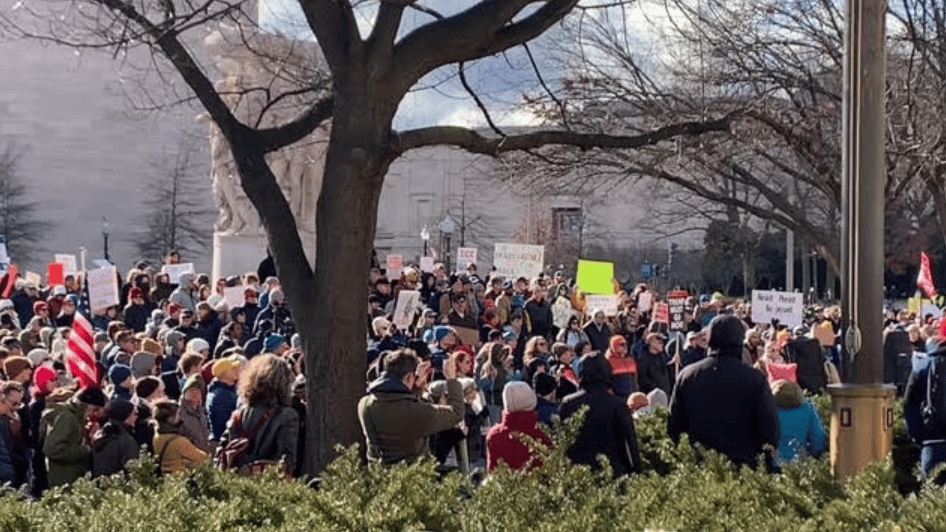
The crowd listens to speakers ahead of the march to ICE HQ. (Photo: A. Pitzer)
The centrist fallacy
What those who showed up this weekend were doing was the opposite in many ways of what we see from much of the pundit class.
On the PBS News Hour, David Brooks addressed the death of Renee Good in Minneapolis. He compared the competing interpretations of videos of her death to that of uncritical fans from opposing football teams at Princeton and Dartmouth.
Brooks implied that Trump’s supporters and his most fervent opponents are equally blind, that politically active Americans are nothing more than members of a team, and that he is the voice of reason. But what is he persuading anyone of? He supports nothing more than a status quo that leaves centrists like him as the referees in an Ivy league power game that most people will never participate in.
Yet even on television news, there were bright spots that suggest ICE protesters and observers are succeeding at raising national awareness. The egregiousness of the video of Renee Good’s death got Jake Tapper—who has, in the past, been a champion of both-sides-ing many issues—to directly confront the narrative being put forth by Kristi Noem and the Department of Homeland Security. What’s more, Tapper tied Noem’s lies directly to the violence against law enforcement on January 6, 2021 during Trump’s attempted coup.
For now, Trump’s most fervent supporters will not change their minds. That’s more likely to happen from skyrocketing healthcare premiums or the economic crash the could result if the president gets control of the Fed and sets banking policy directly.
But the pendulum is already swinging away from the bloodlust and hatred that Stephen Miller and others sparked ahead of the election. Since Trump’s return to office, and especially in recent weeks, public opinion on ICE has begun to shift mightily.

A January 9-11 You Gov survey of Americans (link to full survey in text above).
It’s clear that the more they hear about what’s happening, the less tolerance the American public has for this illegal overreach. This week, a ruling is expected from U.S. district judge Katherine Menendez in the lawsuit brought by the state of Minnesota and the cities of Minneapolis and St. Paul, which are requesting on an emergency basis that ICE be barred from specific violent tactics.

A demonstrator’s sign listing those recently killed due to ICE.
The more that activists can reveal about what’s happening, the more tools more people will have to stop it. When ICE kills civilians in the street or in detention, we can raise the alarm and demand punishment. Motivating independent and less-committed voters is an important part of how short-term change can happen, saving lives.
As more and more people witness the brutality that ICE and Border Patrol are inflicting, it becomes possible to build a public narrative. Documenting the history happening today is likewise critical to the kind of deeper change our country needs if there is going to be any hope for democracy going forward.
Where do you stand?
I’ve asked listeners before to think about where they stand and whether anyone around them in real life would know what they believe. In some cases, it isn’t safe for people to speak out or act, because of their jobs or their personal safety in more extreme communities.
But most people do have some freedom to express their political views, if not by going to demonstrations, then by volunteering in places that will help shore up the lives and the rights of the most vulnerable. Nonprofits and churches across the country are doing it in ways that can keep the risk minimal for those who need to be careful.
If the only evidence of what matters to you in your real life is what you post on social media, there’s a good chance you’re missing your chance to help build a new world. Out there is where all the actual change happens.
This weekend, I was heartened to see National Reporter for Religion News Service Jack Jenkins share video from a church in Minneapolis of what appeared to be a musical director coaching a crowd to sing during a vigil. They were practicing a chant that they would soon sing out in the streets. “This is for our neighbors who are locked inside,” they sang, “together, we will abolish ICE.” After a few repetitions to get the melody, they started switching in the word “children.”
When it comes to our political crisis, I wish we could make social media a little more like that, particularly in moments of crisis. It’s possible to focus on the big similarities instead of small differences. People can connect to learn and take action together. They can get strong enough in their knowledge and the extent of their shared values and vision that they’re able to combine their voices, navigate their differences, find solidarity, improvise, and carry their beliefs out into the world.

Your paid subscriptions support my work.
Reply