- Degenerate Art
- Posts
- March 27 Friday roundup
March 27 Friday roundup
Links to the podcast! Also, thoughts on not doing vile things in dark days.
For the podcast this week, I spoke with Anat Shenker-Osorio about political messaging. She explored pundits’ strange ideas about “moderates” and explained why successful campaigns to win those voters don’t work at all the way most people think they do. You can watch the episode on YouTube or listen to it on Apple, Spotify, and elsewhere. If you’d like to check out the linked material in the written version, you can read it here.
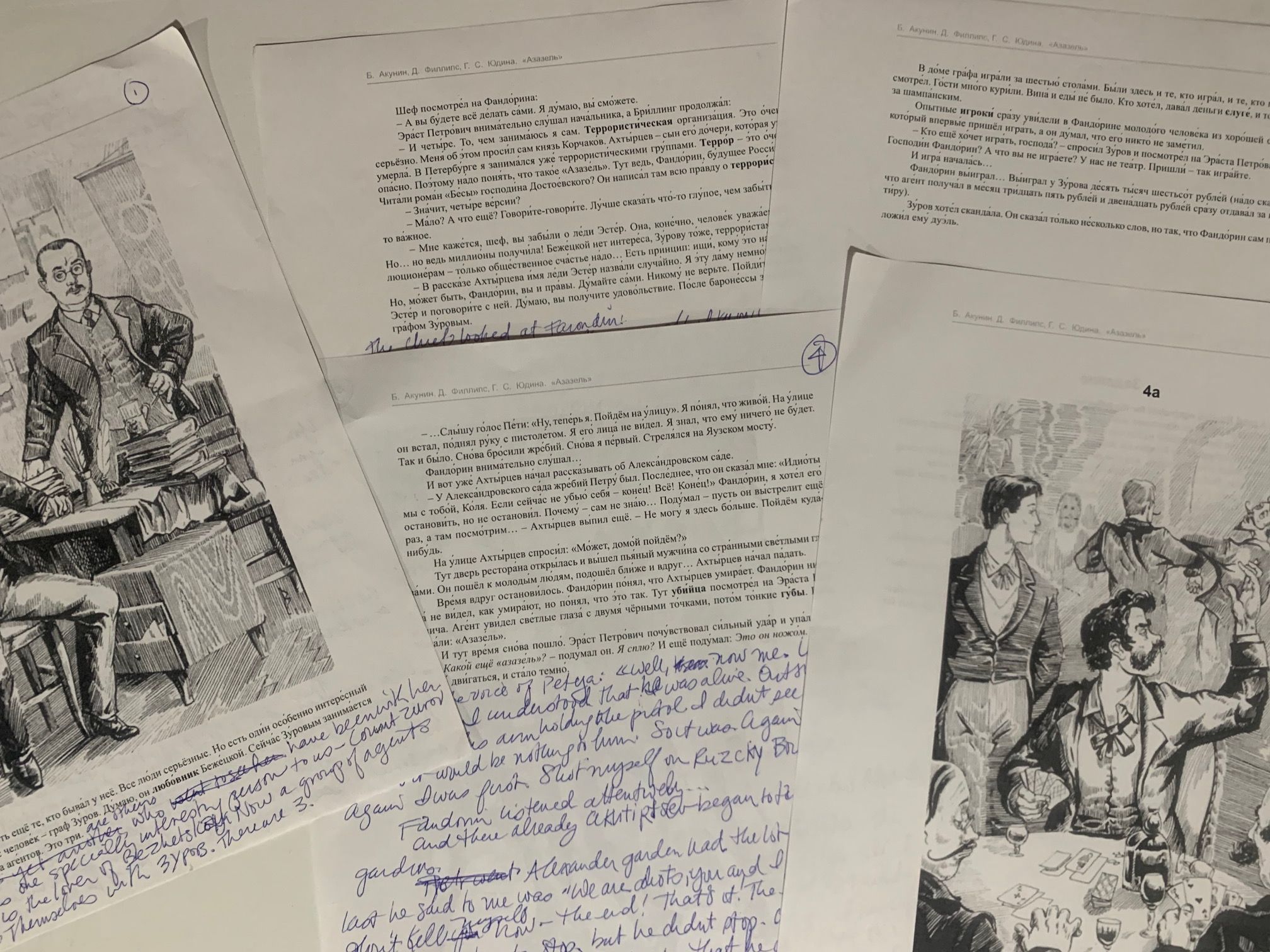
My old Russian class notes translating a (simplified) Boris Akunin detective story.
In this fifteenth month after the return of Donald Trump, looking at prior history at home and in other countries can be helpful for figuring out how to respond as authoritarianism takes root or expands. As I’ve been saying, I expect this crisis to get worse before we see real improvements.
(That isn’t at all to discourage you from acting now. You can definitely prevent harms from happening in real time. And in the larger sense, acting now will likely help mitigate how bad things get and speed up the national recovery when it happens.)
If our situation does get worse in the short run, lessons from those who’ve survived hard times can offer guidance. Boris Akunin is a wildly popular Georgian-born author who grew up in the Soviet Union and left Russia in 2014, the year that Moscow seized Crimea. I don’t agree with him on every issue, but he‘s been steadfast in his recognition of Ukraine’s right to defend itself. Asked about Ukraine bombing Russian territory, and whether Kyiv has the right to strike inside Russian borders, he replied, “If you don’t want a war, don’t start one.”
And Akunin has real insights on the postwar Soviet era, which he lived through. In a recent talk with journalist Katerina Gordeeva about how Russians have adjusted to living in a police state, he addressed present-day conditions there: “There are a great many people there who benefit not only from the war, but from the dictatorship in general… There are many people who are getting rich.”
At the other end of the spectrum, he notes that many of those who were brave and principled have been sent to prison. As for the rest, he continues, “Those who refused to live in this system and could leave, left. The rest—those who could not leave—fell silent.”
“That does not mean that their way of life changed. There is another mechanism there, which I also understand very well. It is the mechanism of a person with self-respect. It is the mechanism of ethical adaptation to unethical conditions. A reflective person, a thinking person, is inclined to look for a justification for why he behaves in this way rather than another. This is really toxic, corrosive, because an intelligent person will always explain to himself why he behaves in this way.
“There are several scenarios there. One scenario is, ‘This is my country, just as it is. I love the way it is. I remain loyal to it. It is a country with a hard history, with a hard legacy.’
“Another story is, ‘Well, what can you do? People have to live. Hospitals have to function. Children have to be taught. This is how we live. You show off over there, while we are doing the actual work every day, carrying all this on ourselves, otherwise everyone here will die of hunger, and there will be nothing here.’
“Then there is yet another position: “My God, we are simply honest here. It’s the same everywhere. Look at what’s going on over there… So don’t be too proud of yourself.’”
How then are conscientious people to survive? Akunin describes rules to endure, handed down from Soviet times:
“First of all, do not get yourself dirty. Don’t take part in vile things. Second, support those who are worse off than you are. That is a very powerful, so to speak, narcotic. If you help someone, you yourself begin to feel much better. And do not change your convictions, your values. That is the bare minimum. Not many people can be heroes… But this is the minimum that my generation learned back in the Soviet Union.”
I’ve been remembering Akunin’s words this week, and thinking about how his Soviet rules might apply to us as this system solidifies a little more each day. Don’t take part in vile things. Support those who are worse off. Don’t let your convictions change. As tests of these principles arise more and more often, try to stay true to yourself.
But the really good news is that while our government institutions have proven so much easier to dismantle than many of us suspected, and the good programs once conducted by the federal government have been so much easier to destroy than we might have hoped, the majority of U.S. citizens are still free to dissent publicly in a way that Soviet citizens rarely could in the past—and Russians cannot today without tremendous risk.
And tomorrow many of us will be out doing so. Dissent is critical to democracy. Dissent underlines that people are the source of political power, not the strongman. Dissent shows that not everything can be stage-managed by political leaders. And large waves of dissent show the country that there are millions who oppose the policies of the police state. If they reject MAGA values, if they reject Trump’s hatemongering, they know they will not be alone.
A happy and great country is not a country that everyone fears…,” Akunin says, “but a country whose people live a decent life and have real choices in that life.”
We can still redeem our country from the criminality occupying the halls of power. The March 28th No Kings gatherings will number more than 3,100 nationwide. One of them is likely to be happening near you. Showing up a small easy step to take for most of us, and a way to begin to exercise small muscles of dissent for use later in more challenging circumstances, should they arrive.
We can make this the largest one-day protest in U.S. history. We can show that we won’t let our choices be taken away. I’ll be covering events on the Memorial Bridge tomorrow morning, crossing over from Arlington Cemetery into DC. I hope to see some of you there, and will be thinking of everyone heading out in body or in spirit around the country.
Your paid subscriptions support my work.
Reply