- Degenerate Art
- Posts
- December 26 Friday roundup
December 26 Friday roundup
Links to the podcast! Also, fuck this year; we're going to start over.
Welcome to the last Degenerate Art post for 2025!
First, a quick note on the podcast episode: this week, I talk about the ways recent attacks against trans people in the U.S. and the U.K. reveal the power of propaganda, and also how Rep. Sarah McBride may be offering useful strategies to defang it. You can watch the episode on YouTube or listen to it via Apple, Spotify, and elsewhere. If you’d like to check out the linked material or the written post from Tuesday, you can read it here.
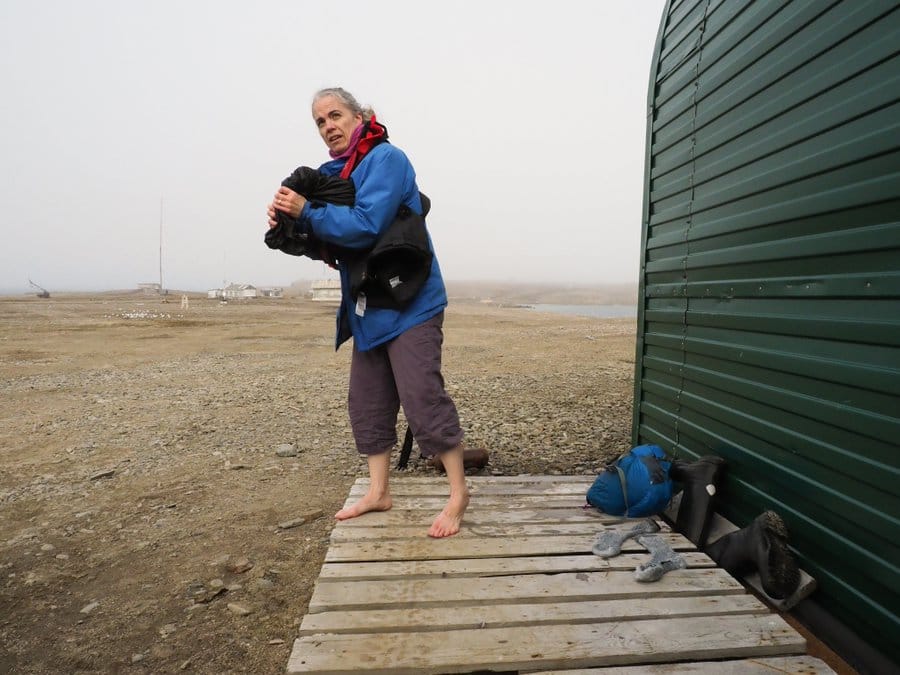
The author wringing out her pants at Cape Desire in the High Arctic, August 2019.
In the interest of honesty, it has to be said that 2025 was a fucking disaster. The litany of bad events was endless. Trump 2.0 has taken a wrecking ball to the U.S. economy, killed hundreds of thousands of people already through cuts to USAID, secured the backing of the U.S. Supreme Court for detention based on race and ethnicity, and delivered funding for a massive concentration camp system in the U.S. and abroad. I’ll stop there, but you get the idea.
Between the newsletter and its sister podcast “Next Comes What,” what I’ve written this year has reached hundreds of thousands of people this year. More than 200,000 words had appeared on the Degenerate Art site in 2025. In terms of sheer volume, that’s the equivalent of two books.
I’ve mostly written about politics and history in this space, because there seems to be a hunger for understanding what authoritarianism past and present can tell us about what’s coming down the pike. My goal has been to be as useful as possible in these grim days.
Some of those 200,000+ words have included stories about my childhood, my adventures working at a record store, and also my reporting in the Arctic. The draft of my next book, SNOWBLIND, has—along with this newsletter—been taking a good deal of my time as well. Which means that compared to other topics, I’ve actually been writing less about the Arctic for the newsletter
That doesn’t mean I don’t spend a lot of time thinking about the polar regions, or am even writing less about the far North overall. You’ll just have to wait a little longer to see that particular story.
In the meantime, I’ll close out this year by telling you about an incident from my first Arctic expedition on a boat—a single, masted smaller vessel—instead of a ship. It was 2019. We had sailed out of Murmansk, an Arctic city in northwestern Russia not too far from the border with Norway.
We were headed to see the ruins of a cabin from the time of Shakespeare, built to shelter a group of Dutch sailors who had been frozen in for the winter with their navigator Willem Barentsz during their attempt to sail the Northeast Passage. (In my book Icebound, I use the name William Barents, which was the standard English rendering in his day and the surname that was given to the sea over which he sailed on his way north.)
After leaving Murmansk that August, we sailed out over the Barents Sea. The waters were choppy and the wind not exactly against us, but more than willing to deny us smooth sailing. Within hours of leaving shore, I was laid low with seasickness, which hadn’t afflicted me at all on my expedition the year before.
Demoralized, I soon realized it could have been worse, because one of the scientists aboard (there were nine of us in all at that point, between the crew and passengers) was even sicker, vanishing into her room for good almost from the point we left the coast. Everyone was worried about her, but it also became a standing joke on board the small vessel to wonder if her roommate had killed her.
To try to focus on something other than my vertigo, I went on deck as much as possible, learning to take the wheel and even to help some with the sails. We made a few landings along the coast at places where Barents had also been.
When we went ashore, I helped to haul in our small boat and drag it up onto dry land. In the way that journalists long to be invisible, to see how events would unfold in their absence, I began to imagine that I was making myself useful, that I might not stand out like a sore thumb or be in the way.
After several days, we drew near the northernmost shores of Novaya Zemlya. Nearing Cape Desire, we were approaching the only polar outpost for hundreds of miles. Each summer two national park employees were dropped off in early summer and brought back before the ice pack formed there.
The captain had explained before we set out from Murmansk that we had only enough water for us to use a liter to bathe in, and that the women aboard couldn’t wash our hair at all. Before the end of the expedition, I would discover this had only been a joke. But faced with cultural and language barriers at the beginning of the trip, I had taken his word as gospel and avoided washing any body part but my face for the first five days at sea, in order to save water.
So it was with great excitement that I’d looked forward to the stop at Cape Desire, where the rangers had built an honest-to-God makeshift banya—a sauna. There would be a fire to heat the water and a large room to clean up to our hearts’ content. I began to imbue my forthcoming bath with almost mystical power.
As we landed and headed onto shore, birds wheeled and screamed. On the way to the station, the ranger who came to meet us chided me in Russian. I looked over to where he was walking on a series of boards laid across the marshy soil. He pointed at his feet, and then at mine. I realized I was crushing countless small flowers that sat nested at ground level. Everything grows so slowly in an inhospitable desert climate; it sometimes takes years for life to stick. I moved quickly onto the planks.
We arrived at the station to find a prefab modular metal building that had gradually spread out through renovations. There was, as promised, a banya. At one end of the dining area, a door gave way to a hallway, which opened to another door, and an antechamber. The room was at least thirty degrees warmer than the hall. Near the floor along one wall, I saw a square metal door, where logs could be fed into the stove that sat in the next room. I opened the hatch. Inside, burning wood blistered and cracked like an invitation.
When my turn came, I take off my last layers of clothes and went into the banya itself. It was surely the hottest room in all of human history, as if hell were heaven. The cook from the boat and my friend Tatiana joined me inside.
On the rough wood floor in a corner opposite the stove sat a barrel of cool lake water. Two tiers of benches ran along the short connecting wall. Hot water on the stove could be combined with lake water in a broad basin to the desired degree of scalding, with a ladle for pouring.
A banya is really just a steam room. But for Russians, it’s a cultural touchstone and a place for bonding. And that day for me, it was a bath and shower combined. I lingered long after the others left.
A window across from the benches looked out on the lake behind the station. Alone in the middle of the room, I studied the landscape while I scrubbed down and dumped ladle after ladle over my head until I thought I would blister or pass out from the heat. It was only a bath in the simplest of rooms—a bare floor, a stove, a barrel of water, and a pane of glass with a view. But it was something else, too.
***
When we left, we took one of the rangers with us, as we were required to for the rest of our stops at historic sites in the Arctic preserve. And at the end of our time on Novaya Zemlya, we returned to Cape Desire to drop him off before beginning our journey hundreds of miles southwest to Murmansk.
As we headed for the cape, I was thinking again of the banya, but had fallen asleep. Someone woke me, so that I could see the dramatic shoreline again as we approached—the same cape Barents had rounded four hundred years before, knowing he was past Novaya Zemlya and believing he would finally get to China.
As the polar station came into view, and I grabbed a coat and boots, so that I could be in the first landing party (our small boat not being large enough to fit everyone at once). I stumbled down the ladder as I was fastening my life jacket, but made it onto the small boat.
As we drew new shore, I was looking down into the clear water at the gravel below. At one point, I thought I heard the first mate, Andrei, at the back, calling “Davai!”—his usual shout as he cut the motor, meaning we should climb out and haul the boat ashore.
Except that he hadn’t said that at all. As I stepped down into the water in my knee-high boots, my legs kept going past the point at which I expected them to touch bottom. I kept going down, and the water kept going up: past the calf, then past the knee, too. Water began pouring into the boots from above.
By the time I stopped sinking, I was in water just over my waist and just above freezing—sheathing my legs in the kind of cold that feels like being stabbed with tiny shards of glass. I reached one hand over a shoulder to haul my backpack higher and keep my camera from getting soaked, while using the other to drag the boat up onto the rocks.
It was good luck that my error happened on that day in that place. If we’d been thirty or forty minutes out from the boat on a windier day and doing a normal landing, I would have been chilled to the bone before any possibility of getting warm again.
I was just as mortified as I would have been if that worse outcome had happened and too embarrassed to look the crew in the eye, unable then in any common language to explain what I’d been thinking. I stayed outside, stripping off my boots, socks, and waterproof pants (which are only waterproof if you don’t make it possible for water to enter them from the waist). I wrung out the sopping clothes and avoided speaking to anyone.
When I went to turn the boots upside down, I realized that the reason I had stumbled in them earlier when climbing down into the small boat was because they were not my boots. I had stolen one of my male shipmates’ boots and flooded them with seawater.
A delicate camaraderie had developed on board, one I had already come to treasure. And I had botched it. When I finally had to go inside the station, due to the cold, I hid under the park rangers’ dining room table when Andrei returned, too ashamed to face him.
It turned out that after dropping everyone off, he had gone into my room and gathered dry clothes for me, as well as a waterproof suit to ride in on the way back. I made another visit to the banya before we left. But the transformation on my second visit to Cape Desire had already occurred when Andrei handed me the dry clothes.
My mistake, which I had honestly been mortified over—would they let me help with landings anymore, would I be allowed at the wheel of the ship?—turned out not to matter at all. The danger that I would have put myself in on any other day of our trip hadn’t come to pass, and everyone moved on.
***
Whenever you do something new, something difficult, you’re going to screw things up. You may well find yourself in unfamiliar and uncomfortable waters. You will meet strange companions. You yourself may become stranger than you are—or at least strange in new ways.
Sometimes your errors will cost deeply. And sometimes you will mess up, and the things you fear most don’t come to pass at all. Neither is a reason not to try to do what needs to be done.
May you never end up waist deep in anything liquid while wearing knee-high boots. But if you do, the communities you build and the chances you take with others to build them can carry you through. They can even become part of the legend of how it is you did the things you will spend your life doing.
I hope you’re all having or have already had happy holidays. Whether you’re a first-time visitor or a weekly regular, thank you for reading Degenerate Art this year. Here’s hoping that the national fever will break in 2026, and that we will all find our roles in making that happen. Joy to you and yours in the New Year.
Your paid subscriptions support my work.
Reply