- Degenerate Art
- Posts
- December 12 Friday roundup
December 12 Friday roundup
Links to the podcast! And saying goodbye to a hometown.
In case you missed the note on Tuesday, I’ll be on break all next week for a book-writing intensive. I’ll return on December 23 for a normal week of Tuesday and Friday posts to close out the year.
In the latest podcast episode, I look at the current attacks on journalism (and all public knowledge), how dangerous they are to democracy, and what we can do about it. You can watch the episode on YouTube or listen to it via Apple, Spotify, and elsewhere. If you’d like to check out the linked material or the written post from Tuesday, you can read it here.
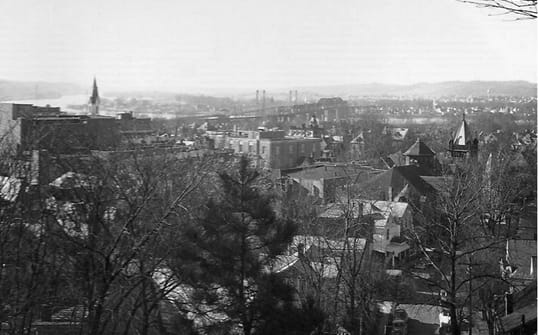
A view of Parkersburg, West Virginia, from Quincy Hill Park in the 1950s.
Today, I’m going to write about leaving. Anyone who’s read my essays about my childhood knows it was a strange one. I was miserable for more than a decade, with a violent stepfather and a mother who lived in a fantasy world. Low-grade terror dominated my home life, and my existence outside our house consisted of full-time awkward alienation. It was a childhood more common than I realized at the time.
One of the relics of that era is that I learned to endure difficulties, which can be a good thing or a bad thing, depending on the situation (because sometimes you shouldn’t endure them). An odder leftover response I still have is that I tend to feel, at a bone-deep level, that whatever situation I’m in is my new forever one. It’s not hard to manage now that I’m aware of it, and it can even be amusing when I have to tell myself, “No, you will not actually be doing your taxes/cleaning your mother’s house/revising this book forever.”
But when I was still a teenager and getting ready to leave my hometown, the feeling was overwhelming, because it was the only life I knew. After getting accepted to a college in Washington, DC. I was planning to go and had arranged everything. Still, up until the last moment, really until I was already standing with my suitcase in my dorm room, I couldn’t believe it could really happen—that I would ever get away.
You, like me, might be thinking about what you or so many around you are enduring now, and how anyone could possibly escape their dangerous situations at a time when everything seems impossible. It’s worth remembering that it’s hard and a process, but people do it all the time.
Still, the younger self I carry with me can hardly believe I got away. Recalling those days now, I think less of my frightened childhood and more about the place itself, and those who didn’t—or couldn’t—leave.
When I remember leaving my hometown, the brick road in front of our vast and ancient house on Madison Avenue becomes the blacktop they laid when I was still in elementary school. Our house sat halfway up a high hill, with a side street that ran around a corner to Quincy Avenue then either up to the park where grown men drove by with their windows down, groping themselves while they called out to little girls, or downhill to the Coliseum, a roller rink where they played ABBA’s “Dancing Queen.”
On elementary school-skate nights, everyone was jealous of the teenagers who had jobs there evenings and weekends, part-timers who could glide backward to the beat, feet crossing and uncrossing, before turning 180 degrees with a tiny airborne hitch, landing face-forward and moving on, as if nothing had changed.
Strobe lighting circled the walls as we orbited the rink in dizzying monotony. It was a childhood version of liquor or drugs, of being transported, of surrendering to a feeling. You could imagine you were someone beautiful, invincible, stupendous: a character in a story. At the end of three hours, coming back to the benches and putting on sneakers, ghost vibrations still echoed in the soles of our feet, but they no longer offered any sense of flying—only clumsy, earthbound steps.
Three blocks farther along Seventh Street, my grandparents’ bookstore stood on the corner at Market, full of the smell of the tobacco shop they added in the back to try to turn a profit, or at least keep from going under. It was somehow the opposite of Mr. Lilly’s used bookshop closer to the floodwall and the river, where my best friend warned me not to go inside alone.
Over on Eighth Street, not far from the enormous Carnegie Library with its glass-block floors, the road bent around a tight curve at Camden Clark Hospital, where my mother and aunt had worked. Two miles past the hospital, McHappy’s Donuts sold bear claws at the last big intersection before the mall, which sat just outside Parkersburg proper and had shifted the town’s center of gravity upon arrival, launching a slow-motion battle that downtown lost a little more each year.
Past Parkersburg’s city limits, Seventh Street was called Route 50 and ran all the way to the Atlantic Ocean. But I hadn’t yet set foot in an ocean, so I could only imagine it. I promised myself that I wouldn’t leave my mother entirely behind—that it was possible to escape without losing her for good.
I wanted to have more without giving up anything. But it didn’t sink in until I was gone that my mother had already left me. I’d had nothing to start with, nothing to bargain with, and therefore nothing to lose.
By the time I walked onstage to get my high school diploma, I had two months left to go. Though my eyes remained fixed on the place I’d lived all those years, I was already receding with distance, finally hitting stride, rolling backward out of town to a place I could barely imagine. Soon even my fear couldn’t stop me, and I would make that leap, turning face-forward, all of it behind me, skating furiously away.
Your paid subscriptions support my work.
Reply