- Degenerate Art
- Posts
- April 3 Friday roundup
April 3 Friday roundup
Links to this week's podcast! Also, a minor note on not fooling yourself.
For the latest episode of the podcast, I went to cover one of the No Kings protests in DC and looked at data from a research team surveying attendees—all to figure out whether the movement can make a difference in the long run. You can watch the episode on YouTube or listen to it on Apple, Spotify, and elsewhere. If you’d like to check out the linked material in the written version, you can read it here.
Even when faced with actual conspiracies, don’t mix up your own Kool-Aid.
Today, I’ll write about the need—especially in perilous times—to double-check facts, sources, and timelines. There are definitely larger conspiracies unfolding right before our eyes (to quash the Epstein files, to destroy democracy, or to put millions of our neighbors into detention camps), as well as quieter efforts to steal and sequester money for the benefit of the powerful and their friends. But not every puff of smoke is a smoking gun. This post is a low-stakes cautionary tale of how easy it is to be wrong when you set out to build a narrative before you have much in the way of facts.
Last November, I wrote about references to Vladimir Nabokov’s Lolita in the first tranche of Jeffrey Epstein’s emails. The financier was obsessed with the novel, recommending it to different people who came into his orbit, and offering to pay a Nabokov scholar to write a book about it. My post looked at at the ways the plot was characterized by the disgraced child molester and his associates, and how—despite the existence of multiple lenses through which to see the story—some interpretations involve willful misreading.
When the next big chunk of Epstein correspondence dropped, I wanted to follow up on the topic. There was a lot discussion in the news at the time about Epstein’s trips to Zorro Ranch, his property in New Mexico, and how an investigation there had been shut down before being reopened this year.
That ranch and disturbing stories about it reminded me of the Duk Duk Ranch from Lolita, where Clare Quilty—the narrator’s quasi-rival and nemesis—had taken Lolita after kidnapping her. In the book, Lolita describes events that had taken place at the ranch to her perverted stepfather Humbert, who paraphrases her account for the reader: “Of course he was a complete freak in sex matters, and his friends were his slaves. I just could not imagine (I, Humbert, could not imagine!) what they all did at Duk Duk Ranch. She refused to take part because she loved him, and he threw her out.”
It occurred to me that as a fan of (and creep about) Nabokov’s most famous book, Epstein might have thought of Zorro Ranch as some kind of parallel to Duk Duk in the novel. I wondered if he might have referenced it in his emails. So I searched on “Duk Duk,” which isn’t the kind of phrase someone—even someone with Epstein’s typos and elliptical phrasing—would be likely to have typed by accident.
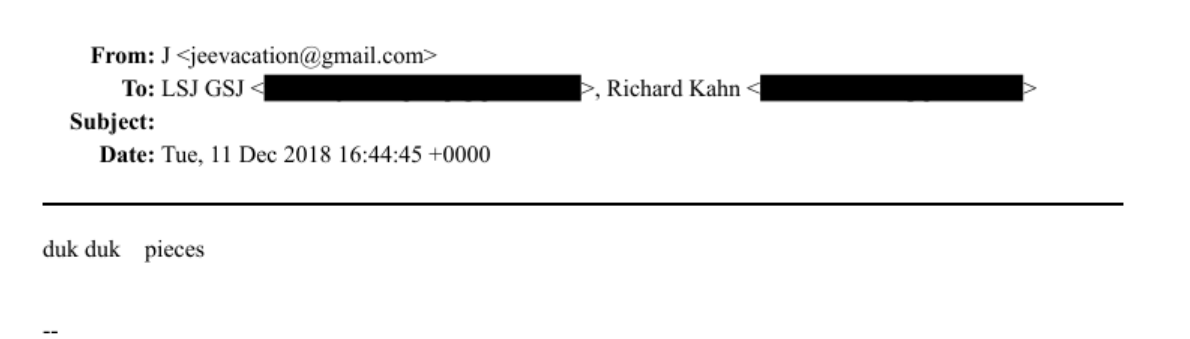
After entering the name, I found not one but four mentions of Duk Duk in the Department of Justice searchable file. I’d hit the jackpot. The first message was a cryptic note from Epstein himself that just read “duk duk pieces.”
This was intriguing. I’d done a ton of literary forensics for my first book, and so many sparks of inspiration turned out to be bigger and more significant than I had ever hoped. Not to mention, Duk Duk is hardly a common term. What were the odds that Epstein writing about it was somehow not a reference to Lolita?
On closer inspection, the four messages were copies or replies including prior messages that all related to a single email. Epstein’s accountant and an email address listed as “LSJ GSJ”—Little Saint James and Greater Saint James, the names of the islands he owned—were included on the messages. One reply to Epstein read, “I left a message with the sales rep yeste=day, she called back giving a contact person in customer service whom I lef= a message with If I have heard nothing my 3pm w=II call sales Rep again.”
The “sales rep” part made less sense. Epstein had long owned his ranch by the time the 2018 email was written—why would he need a sales rep to do anything with it?
So I began searching to see if some other Duk Duk existed that Epstein could have been writing about. And sure enough, soon I found references to an Aboriginal artist who used that name, as well as an entry in Merriam-Webster, which defined it as “a native secret society of islands of the Pacific Ocean, certain of whose members form a self-constituted judiciary and pose as sorcerers.” I found images of relics and practitioners, along with descriptions of tourism that had grown up around them in the early twentieth century, even as Duk-Duk rituals declined.
The odds that this term could appear in Epstein’s correspondence and not be a reference to Lolita had seemed long at first. Yet the more I looked, the more likely it seemed that the “pieces” Epstein referred to were artwork or artifacts he hoped to acquire.
My error was a good reminder that there’s value in double-checking things that seem to perfectly confirm your ideas and assumptions (and by “your,” I mean “my”). It’s so easy to convince yourself that what you already know about the world will explain it in every situation. But sometimes, even in the least likely moments, you can be wrong. And in an age of GenAI slop and deepfakes, of misquotation and deliberate misinformation, why would you want to add an ounce of power to the forces of ignorance plaguing the world?
Your paid subscriptions support my work.
Reply